In marketing and IT, UTM stands for Urchin Tracking Module. These are special parameters added to a website URL. They don’t change how the link works, they simply allow it to be tracked. Thanks to UTM parameters, you can accurately measure the performance of online campaigns and track links in tools like Google Analytics.
UTM parameters help you better understand your website visitors and optimize your marketing and budget more effectively.
For example, you might print several versions of flyers for your business. Each one has a QR code, but without tracking, you won’t know how many people visited your website from the flyers or which version performed best.
UTM parameters can show you, for example:
The beginning of the link is the same as any regular URL. The difference is that instead of ending with a slash, you add a question mark followed by UTM parameters. If you want to include multiple UTM parameters, you separate them with an ampersand (&).
https://luciebubak.com?utm_source=plakat&utm_medium=verze3
Today, there are many tools that can generate a properly formatted UTM link for you, often for free. These tools are called UTM builders, and they make creating UTM links simple and error-free.
Of course, AI can also generate UTM links. However, I prefer using a builder, where I have 100% confidence that the link is correct and don’t need to double-check it.
My favorite UTM builder is the Google Analytics tool by Google:
The basic parameters are source and medium:
If you need more detailed tracking or have multiple variations, you can use additional parameters:
In addition to standard use in advertising, I use UTM parameters in 3 other cases:
Measuring offline marketing results is very difficult. One way to make it easier is by using tracked QR codes.
When you place a QR code somewhere and someone scans it, analytics will usually show that visitor as “direct traffic”. As if they already knew your URL and typed it in.
But that’s not true. The visitor didn’t know your website, brand, or product and without the QR code, they wouldn’t have come.
That’s why I always tag my QR codes based on where I place them – flyers, brochures, business cards. I also track specific versions so I can focus on what works best next time.
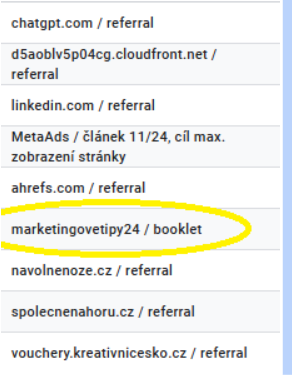
As part of my marketing work with companies, I often run influencer marketing campaigns. When multiple influencers promote the same product at once, it’s not enough to look only at the traffic source in analytics. You can’t tell which influencer actually drove the results.
However, if you give each influencer a tracked (UTM) link, you can clearly distinguish the performance of each one.
(And this definitely pays off because the influencer with the largest following and highest price is not always the one delivering the best results.).
Together with my team, I work on the project Epligo – smart outdoor games .
Usually, I’m the one who starts projects. I set things up, and then the rest of the team joins in and keeps it running.
But in this project, I decided to take a different approach. I only handle minimal tasks and leave the rest to the team – for example, I wrote a newsletter. To separate my contribution from theirs, I tag my links using UTM parameters. (Because I have a much larger audience, even a small activity from me can have a noticeable impact and I want to measure it separately.)
I wrote more about this in my newsletter in August 2025. You can check it out here.
Maybe you’ve wondered, just like I did, what the abbreviation actually means. Why Urchin Tracking Module?
“Urchin” in English means a sea urchin or a street kid which doesn’t make much sense in this context.
The name Urchin Tracking Module (UTM) actually refers to a company called Urchin Software Corporation, which developed web analytics software. Google later acquired it and turned it into what we now know as Google Analytics. So “Urchin” here isn’t about sea creatures or street kids, it’s simply the name of the original company.
To analyze UTM parameters, simply go to your Google Analytics. If you’re not sure how to do it, check out můj článek Jak začít s GA4.