
Mentor Lucie
I briefly mentioned the decoy effect in my previous article on decision paralysis. I explained that this is a pricing strategy used by marketers to “manipulate the customer,” subtly steering them from one product variant to another, specifically to the one that is more expensive for them and more profitable for you as a seller.
The decoy effect is a subtle yet highly effective technique used to “manipulate” customers into choosing a more expensive option while making them feel as though they have actually scored the best deal.
Let’s illustrate this with an example of buying coffee from a vending machine. The machine offers you two options: a regular cup for 30 CZK and a large cup for 50 CZK. Then, a third option is introduced a medium coffee for 48 CZK, which is only slightly smaller than the large one. Suddenly, the large cup appears to be the best possible value.
In his article, strategist Josiah Roche writes: “Although this is a clearly manipulative technique, it works brilliantly. Some companies report up to a 40% increase in sales simply by adding a decoy in the form of a third product option to their portfolio.”
The decoy effect leverages our natural tendency to compare things with one another. It then subtly shifts our preferences toward the option the seller wants us to buy.
You can apply the decoy effect to your business as well, but it is essential to first understand how it works.
In his article, Josiah Roche explains that the psychology of the decoy effect operates on a principle known as asymmetric dominance. This essentially means that one option appears significantly more attractive when placed alongside weaker variants.
“The human brain loves comparing; when it sees that one option clearly stands out above the rest, it will most likely choose it,” Roche adds.
Another principle influenced by the decoy effect is the so-called anchoring effect, which depends heavily on what you see first. “When you see a high price for the first time, it becomes your anchor. When you then catch a glimpse of a lower price next to it, you automatically categorize it as a ‘better deal.’ When you combine this with the decoy effect, a powerful duo is born that your brain can hardly resist.”
Experts from Crowdspring rushed in with an explanation: “The decoy eliminates decision stress and soothes our anxiety about having to choose from multiple similar variants when there is a risk of making the wrong choice.”
The “Paradox of Choice” is another principle of marketing psychology, describing how people dislike making decisions when presented with too many options. “Whatever choice we make is based on personal preferences. The less certain we are about these factors, the more difficult the choice becomes,” adds Maria Jose Guerrero from the Minderest website.
The decoy effect utilizes another psychological principle – loss aversion.
People hate losing more than they love winning.
If you find a hundred-crown bill on the street, it will boost your mood for a moment; however, if you lose that same hundred crowns, it will ruin your entire day.
“Customers do not define loss in absolute terms. They always define it relatively, in relation to something else. Decoys work by manipulating our reference point. Loss aversion then leads us to think more about the disadvantages when making a decision. Something might break. It won’t work. We will lose it. As a result, we tend to choose the absolute best product and often don’t even look at the decoy itself,” explains Ross Kimbarovsky, founder of Crowdspring.
Furthermore, people have a greater aversion to lower product quality than to higher prices. A good decoy is designed to promote quality and come equipped with strong arguments to justify the higher purchase price.
I will show you practical examples that will help you understand how the decoy effect works. We will start with the various coffee cup sizes from Starbucks.
The strategist Josiah Roche, whom you are already well familiar with, clearly described the persuasion technique used by Starbucks marketers. For the sake of transparency, I am listing the coffee cup prices in dollars, exactly as Starbucks offers them. You have three coffee options to choose from:
In this scenario, the Grande option acts as the decoy. Its price and size are strategically chosen to make the Venti option look larger, better value, and more attractive, all for a mere 550 cents more. In reality, the best value option is the Tall, but the customer bypasses it entirely and will choose between the Grande and Venti options, which is precisely the outcome Starbucks wants to achieve.
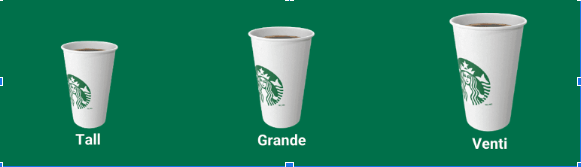
The Starbucks coffee cup size dilemma.
Many of you readers surely subscribe to Netflix. Now you will find out how this multinational corporation manipulates its subscribers. Imagine that Netflix offers three subscription tiers:
The Premium subscription, which includes all possible bonuses and advanced features (such as 4K streaming on a higher number of screens), acts as the decoy. Its price is high enough to make the Standard subscription look like the most attractive option in the offering. At this precise moment, the customer’s natural hesitation to immediately opt for the most expensive variant kicks in. Instead, “to be safe, they will try the middle option first” because they get the impression that it represents the best balance between features and cost.
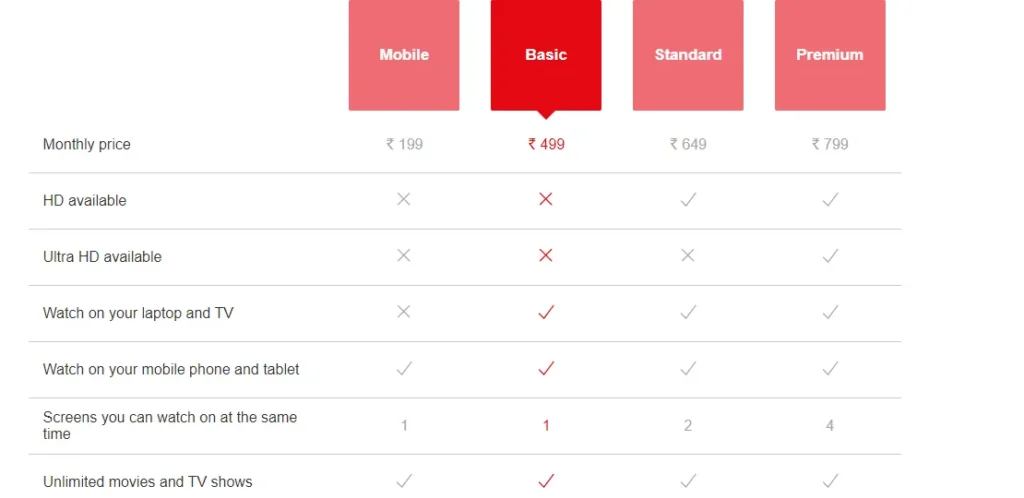
Netflix subscriptions, where the standard tier is the most attractive. Source
Wine shops have their own private decoy system designed to convince customers that the higher the price of a wine bottle, the better its quality. Imagine that you have a choice of three product variants:
In this case, the most expensive wine at 1,000 CZK acts as the decoy, making the 560 CZK bottle appear the most accessible and the best value. Given that customers have visual proof right in front of them that they are choosing a product with the best price-to-value ratio, they are willing to buy multiple bottles of the mid-priced wine rather than just one of the most expensive, which consistently brings sellers a substantial profit.
PLEASE NOTE! It is clear that there will always be buyers for whom price is not a benchmark and who are simply looking for the highest quality. These customers will, of course, buy the most expensive wine.
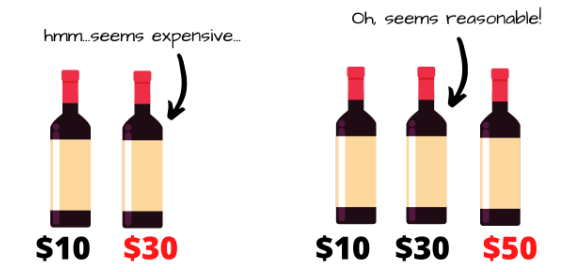
Until a decoy is added, even the middle option is perceived as too expensive. Source
The decoy strategy is undoubtedly extremely effective, as we have shown in the examples. However, it MUST be designed correctly; otherwise, the customer might see through your attempt to manipulate them, causing you to lose their trust within a second. How can you (safely) use the decoy effect in your business, whether you are a beginner or an advanced entrepreneur?
In his article, strategist Niek van Son writes that you should always design the decoy effect based on three parameters:
“Do not forget to add the decoy to two already existing options. Think about what the original two options offer and which selection criteria are most relevant to the customers. Add a strategic decoy that shares only one of the advantages of the other options, which is why it will always be weaker than the second alternative,” advises van Son.
However, always offer a choice of only three options, because more options negate the decoy effect.
I have set up my long-term collaborations on a similar principle – take a look at them in the services section.
The decoy is only there to make the “middle option” as attractive as possible! Therefore, it must be designed in a way that ensures nobody actually chooses it.
Instead of highlighting superlatives, rather downplay it a bit. Show it to people as too expensive, too complex, too absurd, or, on the contrary, too weak compared to the option you actually want to sell.
“The biggest marketing sin is to portray the decoy as an attractive option,” van Son warns. “This triggers the paradox of choice in customers, and in the end, they choose nothing. Realize that the decoy is the option that nobody is supposed to want.”
Josiah Roche recommends using the so-called Goldilocks strategy under all circumstances.
For example, if you sell software, offer customers a basic version for a low price, a premium version for a high price, and a standard version with a price close to the premium one. The premium version then acts as a decoy to make the standard option look like the best value and the most accessible.
“The trick lies in the fact that the price gap between the standard and premium versions is minimal, which subconsciously shifts customers toward the standard option, which is your target sales item,” Roche adds.

Mentor Lucie
I’m the kind of driving force that can move your business forward and help it reach new heights. Make the most of my support, ideas, and experience proven across dozens of projects.


I can honestly say I experienced the best business mentoring ever – mentoring with Lucie.
After just one session together, my perspective on my business expanded tremendously. I gained a new wave of creative energy because now I finally know exactly how to move forward.
We met on Friday, and over the weekend alone I: redesigned my website, became more active on social media, expanded my target audience to a group I would never have considered before, finally gained clarity on how to approach my lead magnet, started seeing a clear path for growth and most importantly, I now feel incredibly motivated to work on it all.
Lucie has a unique gift for seeing things through a true business lens. I’ve never experienced mentoring this effective.
And the best part? I still feel completely like myself, because she built everything authentically around me. She also helped me focus my energy where it truly belongs instead of getting distracted by things that don’t serve me.
Objednala jsem si u Lucie Dědková návod Jak získat první klienty pro svoji službu.
Tohle jsem nečekala!
Videonávod jsem si musela pustit několikrát, protože jsem chtěla, aby se mi všechny informace důkladně vryly do paměti a abych nepřeslechla ani jediné slovo.
Přesto, že je to jen jedno video, je v něm hodně informací a pro mě AHA momentů.
Jsem začínající podnikatelka a chyby, které Lucka popsala, jsem udělala. Pokud s podnikáním začínáte, neváhejte, protože ušetříte mnoho času a energie!
Lucka vám řekne naprosto přesně a jasně, jak začít. A navíc půjdete do akce! Děkuji, Luci!
That’s what I enthusiastically told Lucie during our mentoring session on Friday. I could barely keep my jaw from dropping in amazement, where does she come up with all these ideas?!
Lucie gave me a whole list of tips for my business and helped me see what I’m doing from a completely different perspective, including how I could do it so much better.
The hour flew by. We laughed a lot, which to me is proof that Lucie isn’t just an amazing business mentor and expert, but also a genuinely great person. I wholeheartedly recommend her, and I’m pretty sure this won’t be my last consultation with her.
“I’d really like to thank Lucie for the way she kick-started me. 🙏
If someone had told me that a few simple sentences could pull me out of a place where I’d been stuck going in circles for months, I wouldn’t have believed it… But sometimes, it really only takes a little, someone gently nudging you forward and suddenly everything starts moving again.
I’m a coach, and I absolutely love what I do. But honestly, there are so many newly certified coaches online right now… We often feel lost, small, invisible, and behind everyone else. And because of that, we become afraid to take any step at all… Everything feels awkward, too small, not good enough to stand out among all the coaches who have been here long before us. 😬
Even though I know I provide a high-quality service. Even though I know my energy and skills are unique. Even though deep down I know the projects sitting in my drawer truly deserve to exist in this world… every single step still felt incredibly hard.
Because we beginners are completely overwhelmed by everything we think we have to do and where we’re supposed to start… website, branding, photos, testimonials, sales pages, SEO, email marketing 🙈🤯
Then I found this group – Together Upwards (a business support community).
Somehow, Lucie noticed me in the crowd and reached out to ask what I needed. She gave me a few simple pieces of advice, and the relief I felt was unbelievable 🙌 Suddenly, I took off like a rocket.
So since yesterday, I’ve been following her guidance, and in just one day I managed to: create a clear business plan and finally decide that I’m truly going for it 💪, focus on what actually matters instead of doing everything else around it, step out of my shell and finally start showing up on social media, come up with a way to support coaches like me
Lucie, I’m incredibly grateful to you. And once I work my way through all your programs, I can’t wait to meet you for a consultation 🥳
Thank you, and I wish everyone a beautiful sunny weekend.”
Lucie Klátilová, online course
775 073 383
email@mentorkalucie.cz
Lucie Dědková
podnikatelská mentorka s.r.o.
Varšavská 715/36
Praha 120 00
IČ: 10910999
Společnost zapsána
v obchodním rejstříku.
Created by JK